
*Alnylam is proud to feature real patients in our advertising. Patients may or may not be on an Alnylam therapy.
OXLUMO is the only approved PH1 treatment to lower oxalate levels for all ages and stages of kidney function
All Ages
OXLUMO can be used to treat infants, children, and adults with PH1.†

All Stages
OXLUMO has been studied in patients with a variety of kidney function levels, including those on hemodialysis.†

†In clinical trials, OXLUMO was studied in infants, children, and adults with different stages of kidney disease from near normal (not on hemodialysis) up to advanced kidney disease, including patients on hemodialysis.
OXLUMO® (lumasiran) is a prescription medicine for the treatment of primary hyperoxaluria type 1 (PH1) to lower oxalate in urine and blood in children and adults.
OXLUMO works by reducing oxalate production at the source
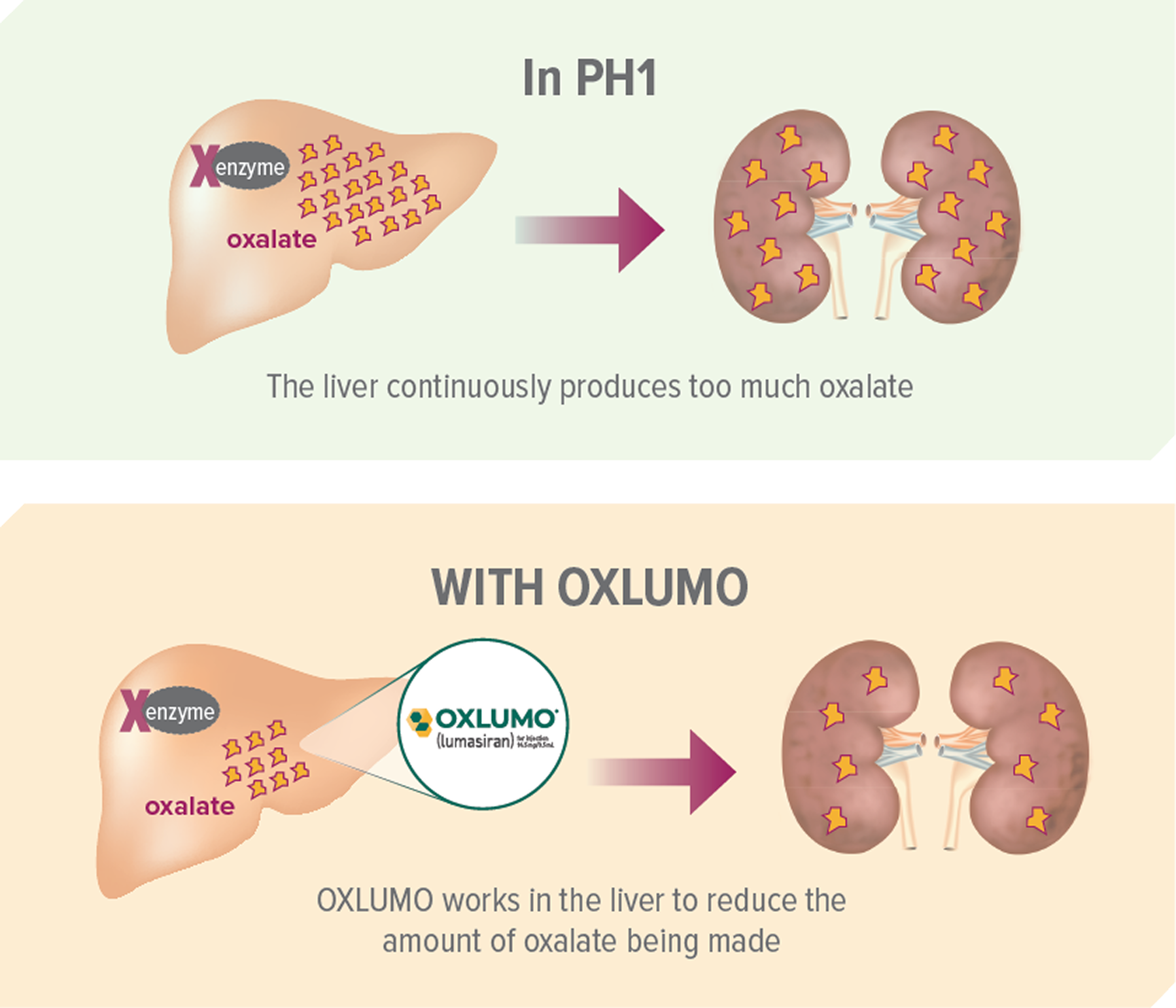
Watch this video to learn how OXLUMO works in the body

CONNECT WITH AN ALNYLAM EDUCATOR
Learn about primary hyperoxaluria type 1 (PH1) and treatment with OXLUMO from one of our trained Alnylam Patient Education Liaisons (PELs).
PELs are employees of Alnylam Pharmaceuticals. They are not acting as healthcare providers and are not part of your healthcare team.
In a clinical trial, OXLUMO was studied in adults and children 6 years and older

In one of the studies, OXLUMO was tested for 6 months in 39 patients with PH1. They were 6 years or older, did not have advanced kidney disease, and were not on hemodialysis.

Patients were put into 2 groups:
- 26 received treatment with OXLUMO
- 13 received a placebo (an injection containing no medicine)

After 6 months, those initially on placebo were switched to OXLUMO, and the OXLUMO group continued receiving OXLUMO.
Because urine is the main way the kidneys remove oxalate, the study looked at the amount of oxalate in urine.
Results after 6 months:

After 6 months of treatment, patients on OXLUMO had on average 53% less oxalate in their urine than patients on placebo
Patients who first received a placebo and then switched to OXLUMO had a similar drop in oxalate in their urine after 6 months on OXLUMO

of patients treated with OXLUMO had normal (52%) or close-to-normal (32%) oxalate levels* in their urine


of patients who had placebo reached these oxalate levels
A normal level of oxalate in the urine means that oxalate levels were no longer elevated above the normal range. A close-to-normal level of oxalate in the urine means that oxalate levels were above the normal range, but were not more than 1.5 times above the normal range.
Results after 54-60 months of treatment:

After 60 months of treatment
Patients who continued OXLUMO had 54% less oxalate in their urine compared to the start of the study

After 54 months of treatment
Patients who switched to OXLUMO after 6 months had 56% less oxalate in their urine compared to the start of the study

How OXLUMO may be able to help
Talk with your doctor to find out if OXLUMO is the right choice for you.
 For more information, download the patient brochure for OXLUMO.
In a clinical trial, OXLUMO was studied in infants and children under 6

Another study included 18 patients who were infants or children under 6 with PH1 who did not have advanced kidney disease and were not on hemodialysis.

All patients were treated with OXLUMO for the first 6 months and then continued on OXLUMO. The study measured oxalate in their urine, since urine is the main way kidneys remove oxalate.
OXLUMO reduced urinary oxalate levels* in younger patients

Patients treated with OXLUMO had 72% lower urinary oxalate levels* after 6 months of treatment compared to the start of the study
*Measured by the ratio of oxalate in the urine to creatinine level.

Patients treated with OXLUMO had 74% lower urinary oxalate levels* after 60 months of treatment compared to the start of the study
*Measured by the ratio of oxalate in the urine to creatinine level.
In a clinical trial, OXLUMO was also studied in patients with advanced kidney disease, including people on hemodialysis

Another study was composed of 21 patients of all ages (including infants younger than 1 year old) with PH1 who had advanced kidney disease, divided into 2 groups:
- Group A: 6 patients who were not on hemodialysis
- Group B: 15 patients who were on hemodialysis
All patients were treated with OXLUMO for the first 6 months and then continued on OXLUMO. The study measured oxalate in the blood, which is where it builds up in patients who have advanced kidney disease.
OXLUMO reduced blood oxalate levels in patients with advanced kidney disease, including those on hemodialysis
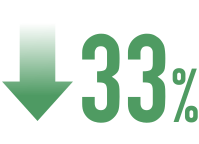

Patients treated with OXLUMO had on average 33% less oxalate in their blood after 6 months of treatment compared to the start of treatment
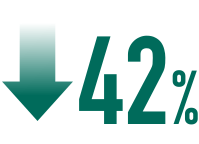
Patients treated with OXLUMO had on average 42% less oxalate in their blood (measured before hemodialysis session) after 6 months compared to the start of treatment
Reductions in blood oxalate levels were consistent for both groups through 24 months
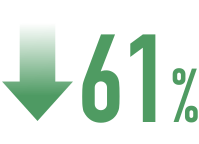
Patients treated with OXLUMO had 61% lower blood oxalate levels after 24 months compared to the start of treatment
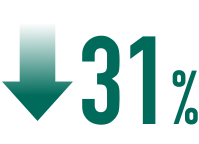
Patients treated with OXLUMO had 31% lower blood oxalate levels (measured before hemodialysis session) after 24 months compared to the start of treatment
Safety profile of OXLUMO
Clinical trials evaluated the safety profile of OXLUMO in 98 patients with PH1. Patients were 4 months to 61 years old at first dose, and included 71 children and 15 patients on hemodialysis.
Injection site reaction
Symptoms included redness, swelling, pain, bruising, itching, and discoloration at the site of injection.


Symptoms were generally mild, resolved within 1 day of injection, and did not result in stopping treatment.
Abdominal pain
Symptoms included stomach pain or discomfort.


OXLUMO had similar side effects to the above in 2 separate studies: One of infants and children (<6 years) and another of patients with advanced kidney disease (including some on hemodialysis) who all received OXLUMO.
In the clinical trial, 26 patients received OXLUMO and 13 received placebo.

For more information about the potential side effects of OXLUMO, talk to your doctor.
You can also read the Prescribing Information.

We're here to help
Find patient support services that can help you and your family during treatment with OXLUMO, including answering questions about treatment and helping support your access to therapy.